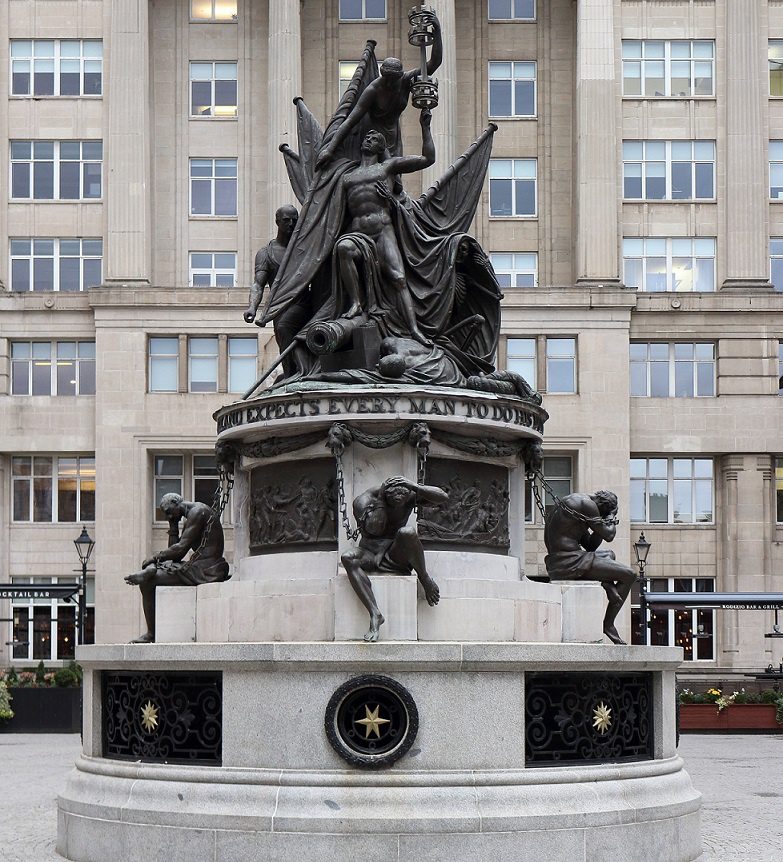

Liverpool is a celebrated city with a rich history. It captivates tourists with its stunning architecture, incredible natural surroundings, and fascinating locations. Today, we delve into the story behind the monument to Admiral Horatio Nelson in Exchange Flags and explore the life of this remarkable figure. You can read more on the iliverpool.info website.
The Monument’s Creation
Back in 1805, Liverpool’s city council decided to erect a monument to honour Nelson’s victory at the Battle of Trafalgar. An initial one thousand pounds was allocated for the design and construction of the pedestal, and a public subscription fund was established. Within two months, the fund had raised almost nine thousand pounds. A competition was then announced to find the best design for the future monument.
Matthew Cotes Wyatt won the competition, and a contract was signed with him in 1809. Three years later, the foundation stone was laid.
The monument was officially unveiled on 21 October 1813, marking the eighth anniversary of Nelson’s death. In 1866, the monument was moved to its current position in Exchange Flags.
It’s worth noting that during the Eurovision Song Contest 2023 celebrations, the monument was protected by sandbags. This was because the contest was hosted in Liverpool on behalf of Ukraine, where the war prevented it from being held. The sandbags were part of an art installation titled ‘Protect the Beats’, mimicking the way monuments in Ukraine have been shielded from damage during the Russian invasion.

About the Nelson Monument
While a picture is worth a thousand words, we will try to describe this work of art. It is a bronze sculpture set on a stone base, standing 8.8 metres tall. The circumference of the base is approximately 29 metres.
The base consists of a drum-shaped pedestal resting on a granite foundation. Around the pedestal are four statues depicting shackled prisoners. Between these figures, you can see four bronze bas-reliefs that symbolise the naval battles in which Nelson fought.
Notably, the monument was the first piece of public sculpture in Liverpool. It is listed on the National Heritage List for England as a Grade II listed structure.
Who Was Horatio Nelson?
Horatio Nelson was a famous British naval commander and Vice-Admiral. He was victorious in many sea battles, but the most renowned was the Battle of Trafalgar in 1805, where he was fatally wounded.
Nelson was born into the family of a parish priest. At the age of 12, he joined the navy, initially serving as a cabin boy on his uncle’s ship before sailing on both merchant and military vessels.
The young man advanced quickly through the ranks, becoming a naval lieutenant in 1777 and a captain just a year later.
In 1781, Nelson was appointed commander of the 28-gun frigate ‘Albemarle’. He married in 1787. Nelson was known for his strong sense of justice and his active fight against smuggling. This created many enemies for him, including among officials. He was removed from active service for five years, but the outbreak of the French Revolutionary Wars changed everything, and he returned to the navy.
His life was filled with battles: in 1794, he played an active role in the fighting near Toulon; in 1795, he distinguished himself in a naval battle by forcing a French ship to surrender; in 1797, he participated in the Battle of Cape St. Vincent; and later that year, he took part in an attempt to capture the port of Santa Cruz de Tenerife. However, the most crucial battle of his life was Trafalgar. Thanks to Nelson’s courage and persistence, Great Britain secured a decisive victory, but during the conflict, he was shot by a French sniper.