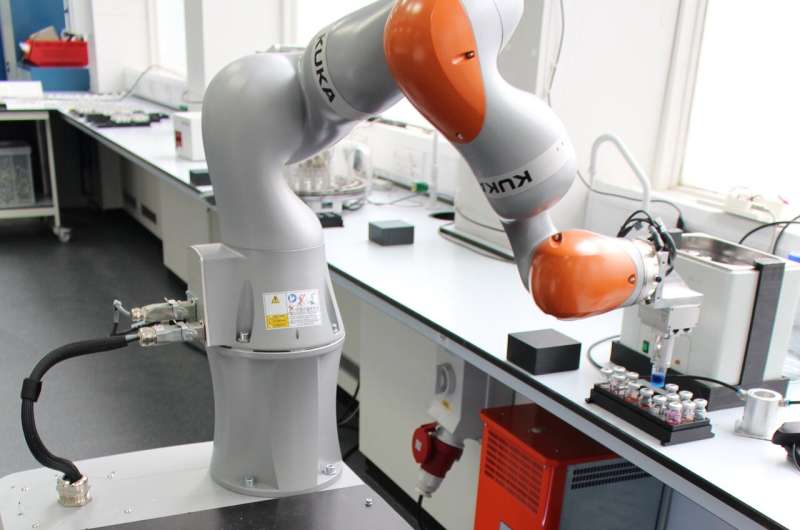

The 21st century never ceases to amaze. Every day brings new research, inventions, and innovations. Scientists and researchers are constantly pushing boundaries, and today, we’re talking about a groundbreaking robot scientist created by Liverpool-based researchers. You can read more about this fascinating development on iliverpool.info.
Capable of Working Around the Clock
Researchers in Liverpool have once again stunned the world with the creation of an intelligent robot scientist that has successfully discovered a new catalyst. This innovative robot can work 24 hours a day, conducting experiments entirely on its own.
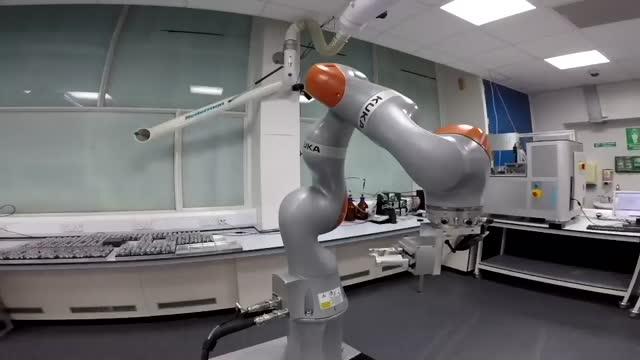
This remarkable machine also independently decides which chemical experiments to perform next, operating seamlessly within a standard laboratory environment.
It’s worth noting that, unlike its human counterparts, the robot scientist possesses immense patience, thinks in 10 dimensions, and only pauses to recharge its battery. Weighing approximately 400 kilograms, it boasts humanoid dimensions, standing at 1.75 metres tall.
What the Robot Scientist Can Do
The robot developed by the Liverpool researchers boasts a wide range of capabilities. This metallic marvel can operate equipment designed for human use and independently carries out all experimental tasks. This includes weighing solids, dispensing liquids, removing air from vessels, initiating catalytic reactions, and quantifying reaction products, along with performing laser scanning and more.
When it comes to catalyst creation, the robot’s “brain” employs a search algorithm to navigate a 10-dimensional space. From a staggering 98 million candidate experiments, it pinpointed the optimal one. As a result, the robot autonomously discovered a catalyst that is six times more active, all without any additional guidance from the research team.
In total, the robot scientist conducts 688 experiments within an eight-hour shift. It operates for 172 out of every 192 hours, executing 319 movements and 6,500 manipulations.
This highly capable assistant was created by University of Liverpool postgraduate student, Dr. Benjamin Burger. He explained that the most challenging aspect of the work was ensuring the system’s reliability, allowing the machine to operate autonomously for several days, performing thousands of delicate manipulations. Once achieved, Benjamin observed that the robot made significantly fewer errors than a human operator.
The project was led by Professor Andrew Cooper from the University’s Department of Chemistry and Materials Innovation Factory in Liverpool. He revealed that their goal was to automate the research process, and in doing so, they created not just another robot, but a powerful team member. This machine frees up human researchers’ time for creative thinking and the development of new, exciting projects.
The History of Robot Creation
In modern society, we’ve become accustomed to robots that can fully replace humans in certain areas. However, the technological predecessors of robots were automatons – mechanical devices capable of mimicking human actions.
In 1949, British neurophysiologist and inventor William Grey Walter created battery-powered robots shaped like tortoises that could manoeuvre around objects. The first stationary robot, however, was an electronically controlled hydraulic arm. This machine could repeat arbitrary sequences of movements and was the brainchild of American engineer George Devol, who developed the device in 1954. Just five years later, his Unimate prototype was unveiled at a General Motors foundry.
Robots have undoubtedly become an integral part of our society. Whether this is a good or bad thing remains a rhetorical question, as machines are replacing people and automating industry.
We hope you found this article informative and that it provided you with some valuable insights.