

Many talented people have been born in Liverpool, and their work has brought fame to our city and region. Today, we turn our attention to the distinguished British mathematician John Conway, creator of the cellular automaton known as the ‘Game of Life’. His work also spanned the theory of finite groups, knot theory, and number theory, among other fields. We will now explore the life story of this eminent local figure. Read more on our website, iliverpool.info.
Childhood and Youth
The future mathematician was born in Liverpool in 1937. He grew up in a large family and inherited his father’s passion for reading and a love for demonstrations. At the same time, he was quite a withdrawn child.
In 1956, the young man entered Gonville and Caius College at the University of Cambridge. At university, John began to socialise with his peers and became actively involved in extracurricular activities. He also met Michael Guy, who would become his best friend and, later, a co-author on many of his works.
In 1961, John married, and the couple went on to have four daughters.
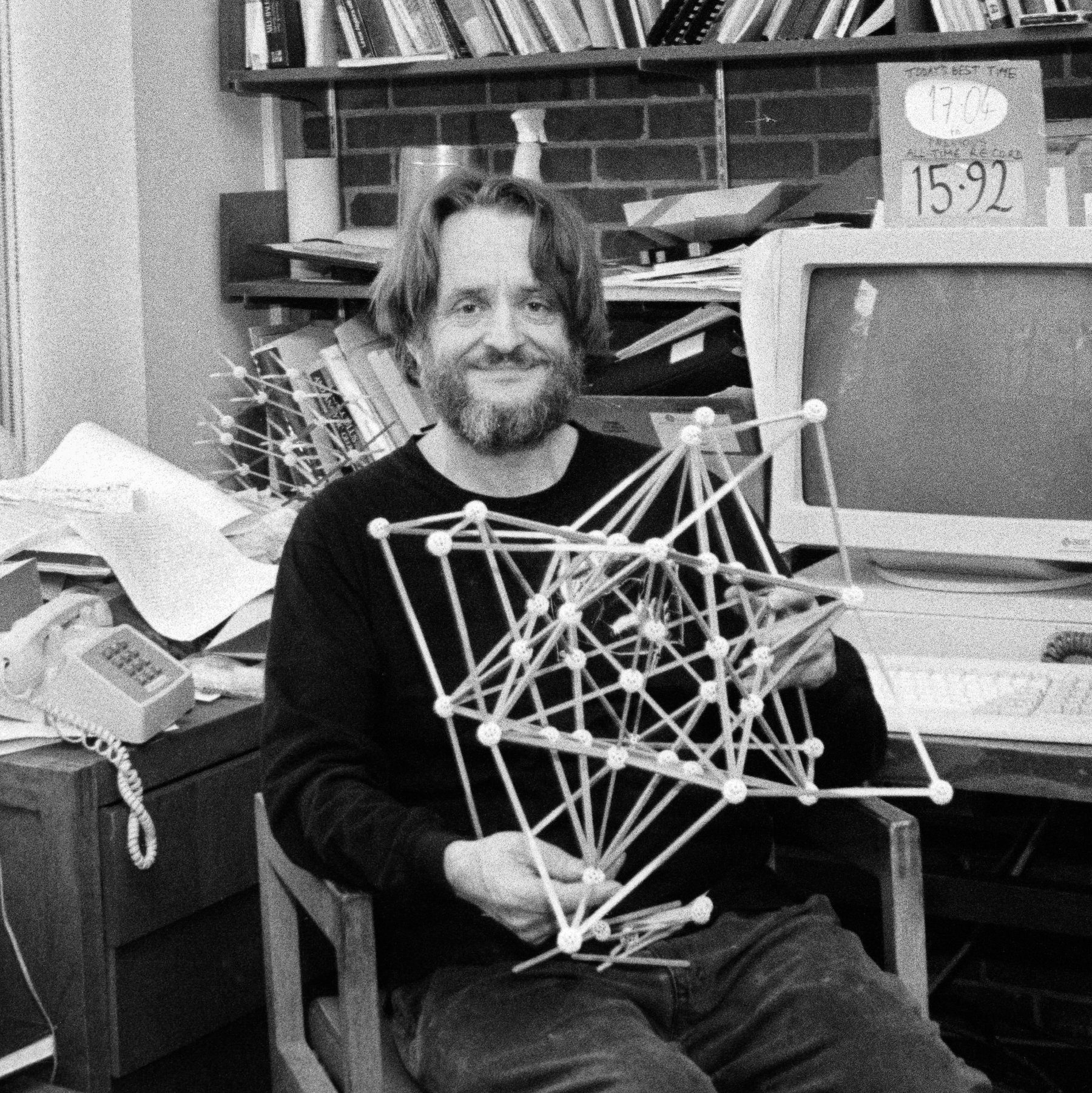
Career Development
In 1959, our local talent graduated from college with a bachelor’s degree. Conway began lecturing at the same college and became popular among the students. He had a knack for explaining complex topics, using vivid examples, and even performing magic tricks. It should be noted that he did not have a strict lesson plan. On one occasion, his student, Andrew Huma, took detailed notes of one of John Conway’s lectures. These notes were requested by many students, including the lecturer himself. In time, these notes were transformed into Conway’s first book, “Regular Algebra and Finite Machines”.
The Liverpool native played many mathematical games, which he himself invented. With one student, he created the topological game ‘Sprouts’, which became popular during that period.
In the 1960s and 70s, the mathematician’s activity was prolific. He created the rules for the ‘Game of Life’ and worked on the classification of finite simple groups.
In 1979, Martin Gardner wrote about the game in Scientific American magazine, and the article became extraordinarily popular. Subsequently, the ‘Game of Life’ gained thousands of followers across America.
It’s worth noting that John quickly lost interest in the topic. The ‘Game of Life’ was in high demand among users, and no one paid attention to his other work. This irritated the mathematician.
Conway co-authored the book “Winning Ways for Your Mathematical Plays”. In 1976, he wrote his own book, “On Numbers and Games”, which dealt with combinatorial game theory and surreal numbers.
In the 1970s, he decided to create a reference book on finite groups, which was titled “Atlas of the Finite Groups”. The project involved postgraduate students and colleagues and took several years to complete. During this period, John was also working on books about games.
Between 1986 and 1987, John was at Princeton University in the United States. He was offered a position there and accepted it.
Personal Life
John Conway was married three times. After his second divorce, he suffered a heart attack and even attempted to take his own life. In total, Conway had four daughters and three sons from his three marriages.
Following his relationship difficulties, he regularly gave public lectures on various topics and taught at mathematics camps.
In 2018, John suffered a stroke, and in 2020, he passed away from complications following COVID-19.
Such is the life story of a distinguished British mathematician who made many discoveries in his field and created a popular game.
We hope you found this material informative and learned more about this famous local figure.